

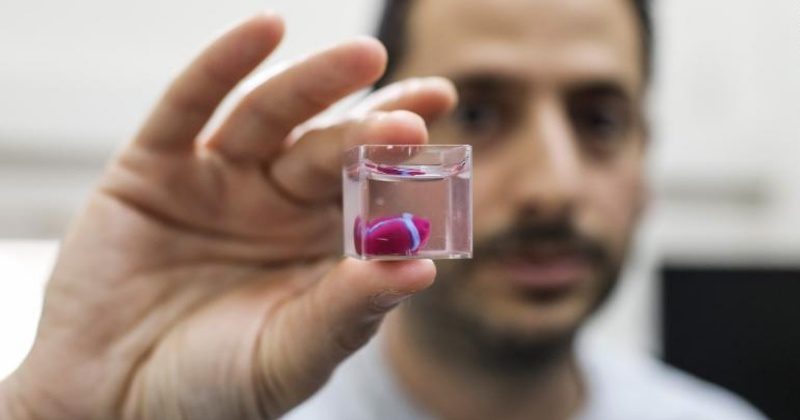
Since the method was perfected 3D printing, its use has not only been commercial but also scientistToday we can celebrate the first 3D printed heart with human tissues.
Although 3D printing has been studied for decades Its boom began in 2003Science has used this method to be able to materialize their researchThis has resulted in the success of many researchers, being mostly in the field of medicine.
Thanks to 3D printing it is possible replicate bones of the body for use as custom implantsThe whole world is celebrating the scientists from Tel Aviv University who presented a prototype of 3D printed heart with human tissue and blood vessels.
Biotechnology applied to 3D printed heart
Previously, regenerative medicine studies Also known as Biotechnology, they managed to 3D print simple tissues, but without blood vessels.
This time the team of scientists from the Tel Aviv University this time they created a procedure which allows not only produce, from cells obtained from the patient's tissue the hydrogel used to mold cardiac patches vascularized, but also They managed to make entire cellular structures with their main vessels.
“This is the first time anyone has successfully designed and printed a complete heart packed with cells, blood vessels, ventricles and chambers“This is a very important step in the fight against cancer,” said Professor Tal Dvir of Tel Aviv University’s School of Molecular Cell Biology and Biotechnology in a statement.
Tal Dvir also explained that, They managed to print a whole heart that is completely biocompatible with the patient. and will not provoke an immune response. On the other hand, he also noted that The printed hearts are the size of a rabbit's, but it could be increased to reach that of a human heart.
Tal Dvir estimated that, In a year, the printed hearts will probably be transplanted into animals for the first time.
This new advance of the biomedicine could save the lives of thousands of patients with cardiovascular diseases. Since, until now, the only option available to them is heart transplants. These are usually limited, and many bodies reject them.
Science and technology join hands once again to continue changing the world. We hope to celebrate the first 3D-printed heart transplant soon. Tell us in the comments. Have you already had the opportunity to experiment with 3D printers?
Image: CNN





 Español de Colombia
 English
 Português do Brasil