

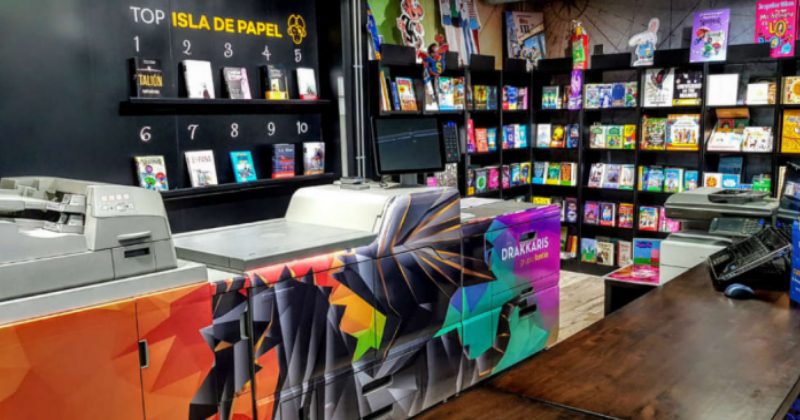
You go to a bookstore, order a book, and they tell you it's out of stock. But they add that if you wait a few minutes, they'll print it for you. Yes, that's possible with Dragon, a Machine that allows you to print a bound, softcover book in 5 to 8 minutes.
This way, the Sevillian literary group Lantia premiered in one of its bookstores, Paper Island, the printing machine Dragona, which came to revolutionize book acquisition. Prints books requested on demand.
Meanwhile, the customer can continue browsing other books in the bookstore and may want to buy another one. With Dragona, bookstores save themselves from having to carry a large number of books in inventory. So they can invest that money in ink, paper, and printing materials.

This solution is ideal for anyone who likes to read a physical book, touch it, smell the scent of the ink on the paper, and not spend all their time looking at a device screen.
Lantia's idea is to eliminate the concept of an out-of-print book or the backlist of books.These are the ones that sell very few units per year, less than 100. They also cover a more extensive catalog of titles available to readers.
To date, Lantia offers a catalogue of 30,000 references and titles from 142 publishers. Dragona can print, bind, dry, and glue in just minutes at the touch of a button. Meanwhile, the reader can enjoy a cup of coffee or browse through a book in the bookstore.
How did the idea for Dragona come about?
The idea was born on a visit to New York City, when I saw the Express Book Machine.A team that printed books in minutes. With this idea the Spaniards returned to Seville and together with the Ricoh company developed the prototype. This, according to Lantia's director, Chema García.
Although the investment cost hasn't been specified, it's known to be a significant amount. Therefore, they prefer not to give a printing price, as they are just starting out. They plan to rent said equipment to other bookstores to expand their market. Because Dragona's profitability is generated when 14 titles are printed per day.
The management of Dragon It's very simple and has software that prevents unauthorized printing. It can also print books in almost all sizes and qualities available in the book industry.
It should be noted that the sales price of the print will be the one set by law as if it were published in the traditional way. Comparing both methods, with Dragona incurs higher printing costs, but lower logistics and distribution costs..
Obviously, it would also work as an option for independent publishers, allowing each author to manage their work. Finally, what do you think of this idea for those who love to read books?
Image: The House of El






 Español de Colombia
 English
 Português do Brasil