

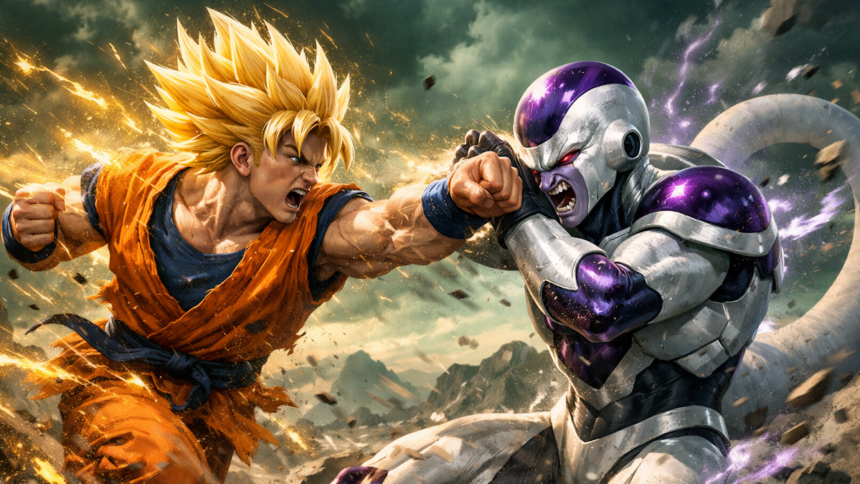
We all love Dragon Ball Z, which we have to accept, but if you were to rewatch the original series today, you'd probably lose your patience. Between the five minutes of screaming to transform into Super Saiyajin, the endless stares on Namek, and entire episodes where absolutely nothing happened, the pacing was, to be kind, maddening.
- Why did they create Dragon Ball Kai (The problem of the 90s)?
- Z vs. Kai: The Big Difference (Beyond the Obvious)
- The Elephant in the Room: Is it Canon?
- Express (But Lethal) Summary: Chapters 1 to 167
- 1. Saga of the Saiyajin (Episodes 1 - 16)
- 2. Saga of Freezer (Episodes 17 - 54)
- 3. Saga of the Androids and Cell (Episodes 55 - 98)
- 4. The Final Chapters: Majin Buu Saga (Episodes 99 - 167)
- 5 Curiosities that will leave you as a Namekian in Dragon Ball Kai
This is exactly where our protagonist today enters the field. Is it a remake? Is it a cheap remastering? Or is it the ultimate way Akira Toriyama wanted us to consume his magnum opus?
Dragon Ball Kai is a remastered and re-released version of Dragon Ball Z, released in 2009 to celebrate the 20th anniversary of the franchise. Its main goal was to remove all the original “filler” content (scenes and chapters that did not exist in the manga) to offer a faster experience, faithful to Akira Toriyama's printed work, and in high definition (HD). Now let's take this beast apart piece by piece.
Why did they create Dragon Ball Kai (The problem of the 90s)?
In the 1990s, the Dragon Ball Z anime was broadcast at about the same time that Akira Toriyama was drawing the manga. This created a massive problem: anime was catching up with manga too fast.
To avoid pausing the series, Toei Animation resorted to the sacred art of filler. Remember Goku and Piccolo trying to get a driver's license? Pure comedy gold, yes. Did it add anything to the Android saga? Absolutely nothing.
In 2009, with HD technology dominating the market and a new generation of fans on the doorstep, Toei decided to clean house. They took the original 16mm negatives of DBZ, scanned them in HD, cleaned up the time damage, recorded new dialogue with the original voice actors (those still alive, of course) and got out the scissors. From the original 291 episodes of Z, Kai cut the story of Freezer and Cell down to an efficient 98 chapters.
Z vs. Kai: The Big Difference (Beyond the Obvious)
If you think the only difference is that it looks “prettier,” you're missing half the movie. The visual and sound experience changes drastically.
| Feature | Dragon Ball Z (Original) | Dragon Ball Kai (Remaster) |
| Episodes (Total) | 291 episodes | 167 episodes (including The Final Chapters) |
| Aspect Ratio | 4:3 (Old TV format) | 4:3 (Original) and 16:9 (Cropped for modern TV) |
| Loyalty to Manga | Low-Medium (Lots of Toei original material) | High (Follow the rhythm of the manga, bullet point by bullet point) |
| Blood and Censorship | High graphic violence and visible blood | Moderate censorship (less blood, disguised wounds) |
| Voice Performance | Classical (sometimes rushed) | Re-recorded (Cleaner, but without some deceased vocals) |
Kenji Yamamoto's musical scandal
Here comes the good stuff. The original Kai soundtrack was composed by Kenji Yamamoto and was epic... until someone on the internet noticed something obscure. Yamamoto had been shamelessly plagiarizing music from Western rock bands for years. (such as Pink Floyd and Stratovarius) and even Hollywood movies.
Toei Animation panicked, fired Yamamoto in the middle of 2011 and urgently replaced all Kai tracks with the classic soundtrack by Shunsuke Kikuchi (the composer of Z). If you watch Kai today on official platforms, you will hear the 90s music pasted over the HD image. A fascinating production disaster.
The Elephant in the Room: Is it Canon?
The short and direct answer: Yes, Dragon Ball Kai is the most canon animated version of Dragon Ball Z.
In the anime world, “canon” means that the story belongs to the official universe created by the original author. Since Kai removed Toei's filler (like the fake planet Namek or the Garlick Jr. arc) to stick religiously to Akira Toriyama's manga, it's the ultimate experience for story purists. If Toriyama didn't draw it on paper, Kai wiped it off the map.
Express (But Lethal) Summary: Chapters 1 to 167
Going into 167 chapters can be lazy. Here's the anatomy of the series condensed. (Note: Kai was divided into two parts. The first one covered up to Cell. Years later they released “The Final Chapters” to cover the Majin Buu saga).
1. Saga of the Saiyajin (Episodes 1 - 16)
Raditz lands on Earth, ruins the peace, and we learn that Goku is an alien. Goku dies (for the first time), trains with Kaiosama, and is resurrected just in time to face Nappa and an arrogant Saiyajin prince named Vegeta. The Goku vs. Vegeta fight remains one of the franchise's highest peaks. Pure brutality, zero filler.
2. Saga of Freezer (Episodes 17 - 54)
Destination: Namek. Krilin, Gohan and Bulma go in search of the original dragon spheres, but run into the galactic tyrant Freezer. Kai shines here spectacularly - that infamous Goku vs. Freezer battle that in the 90s lasted 19 episodes and hours of television? Kai compresses it to what it really was: a frenetic, violent, straight-to-the-point fight, culminating in the legendary first transformation into Super Saiyajin.
3. Saga of the Androids and Cell (Episodes 55 - 98)
Trunks from the future arrives warning of a robotic threat. We meet Androids 17 and 18, but the real terror is Cell, a bio-android that absorbs people to reach its perfect form. This saga is highlighted by the development of Gohan, who finally unleashes his hidden power (Super Saiyajin 2) to destroy Cell. This is where the original Kai ended in 2011.
4. The Final Chapters: Majin Buu Saga (Episodes 99 - 167)
Launched in 2014. 7 years have passed. Gohan goes to high school, Goku is dead (again) but comes back for a day, and an evil wizard revives a giant demonic chewing gum named Majin Buu. Although this part of Kai tried to cut out the filler, Buu's saga was chaotic even in the manga, so the pacing here is a bit denser. We end with the epic Universal Genkidama and Goku's farewell.
5 Curiosities that will leave you as a Namekian in Dragon Ball Kai
The mystery of the “Kai”: The word “Kai” (改) in Japanese literally means “Updated”, “Modified” or “Altered”. It was never a randomly chosen name.
Radioactive colors: Some fans hated Kai at first because, when the footage was digitized, the colors were extremely saturated. The yellow of the Super Saiyajin almost burned the retinas compared to the pastel tone of the 90s.
Mr. Satan, the survivor: Despite cutting out the filler, Kai left almost all of Mr. Satan's comedic scenes during the Cell Tournament intact. Toei knew his comedy was untouchable.
Green blood: In some international broadcasts (especially on Nicktoons), Kai was hyper-censored. They would turn the blood into sweat or change the color to green or black to keep it from being graphic.
The Immortal Opening: Dragon Soul, Kai's opening theme, became an instant hit, getting many fans to embrace the change thanks to the adrenaline rush it gave before each episode.
Image: Geekine




 Español de Colombia
 English
 Português do Brasil