

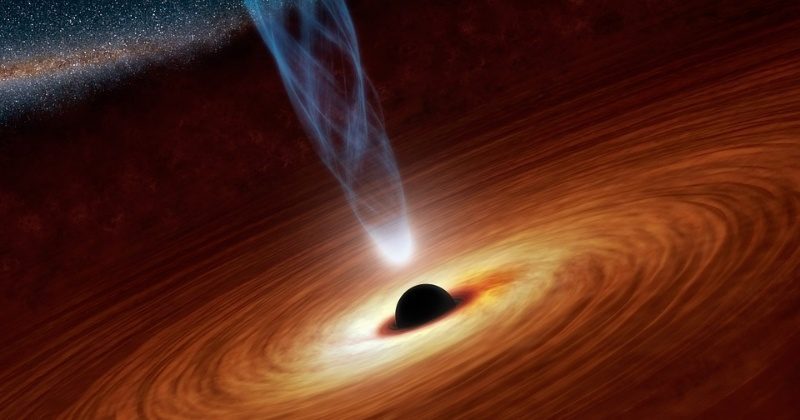
One of the major questions for the scientific community Globally, space-related issues were revealed. Yes, astronomers, Astrophysicists and even amateurs wondered what they were really like. We're talking about a Black Hole And first of all, the images that had been seen were simulations based on theoretical models, following the physical laws we know.
Now then, the Black holes are celestial bodies with a large mass in a very small volume. Because its internal mass is very dense and high, it generates such a strong gravitational field that not even light or matter can escape from it.
An example of this is if our planet had the volume of a marble but the same weight. In other words, it would be a very small and extremely heavy object.
A historic event
On April 10, 2019, at 3:00 p.m., the European Commission, he European Research Council and the International Event Horizon Telescope Project (EHT, for its initials in English) presented an unprecedented result in the observation of these space monsters.
This being the first time an image of a black hole has been displayed, located about 55 million light-years away. In a massive galaxy, call from Messier 87 (M87), in the Virgo cluster. Where the central dark area is the shadow of this giant.
The photographed black hole He was baptized as Powehi. The name was given by Larry Kimura, a professor of Hawaiian language at the University of Hawaii at Hilo. The meaning It refers to a Hawaiian phrase that means “dark fountain, embellished with endless creation.”.
How did they get the image, the black hole?

To capture the image, hundreds of scientists made a monumental effort. It's like photographing an object the size of an orange on the Moon from Earth, and with a resolution good enough to even recognize the target.
So, for 5 days in April 2017, specialized astronomers They were observing with powerful radio telescopes around the world. In this way they functioned as one and had the power of a telescope the size of our planet Earth.
The radio telescopes involved in the enormous research are the following:

- Submillimeter Telescope (SMT) in Arizona, United States.
- James Clerk Maxwell Telescope (JCMT) and Submillimeter Array (SMA), both in Hawaii, United States.
- Also the Large Millimeter Telescope (LMT) from Mexico
- The Atacama Large Millimeter/submillimeter Array (SOUL) and Atacama Pathfinder EXperiment (APEX), both in Chile.
- International Research Institute for Radio Astronomy (IRAM) in Spain.
- And the South Pole Telescope (SPT).
Following the observations, The scientists studied and processed them for 2 years, In addition to the photo, they also obtained some impressive data. They determined that It has a gravity well of about 40 billion kilometers, which is equivalent to about 3 million times the diameter of the Earth. Furthermore, they estimated that It has a mass approximately 6.5 billion times greater than the Sun. Obviously astronomical numbers.
Of equal importance, the image shows the event horizon, which is the edge of the shadow. A place where the force of gravity is immense, preventing the light from escaping.
We can also see a very bright ring of fire surrounding the black hole. In fact, that luminous area is super-hot gas being absorbed by this colossal monster.
And to top it all off, that ring is so shiny, that It surpasses the brightness of the millions of stars in the galaxy combined..This is why it could be captured by radio telescopes.
A long-standing project
In the year 1993, teacher Heino Falcke came up with the idea to combine several telescopes and power to take a photograph of a black hole, being a doctoral student.
He reasoned that these black holes would generate radio emissions around them. Therefore, if that radiation was powerful enough, it would be detectable from Earth.
So, Falcke insisted on his idea, until he finally managed to convince the European Research Council. They funded the beginning of the project. Then the US National Science Foundation and other similar organizations joined in, contributing more resources. In the end, The investigation had a budget of approximately $50 million..
Although it was an arduous investigation, It paid off; for Professor Falcke, the goal was achieved. And it was a major breakthrough for astronomy and science. Tell us what you thought of the image. Did it meet your expectations?
Image: Pixabay








 Español de Colombia
 English
 Português do Brasil