

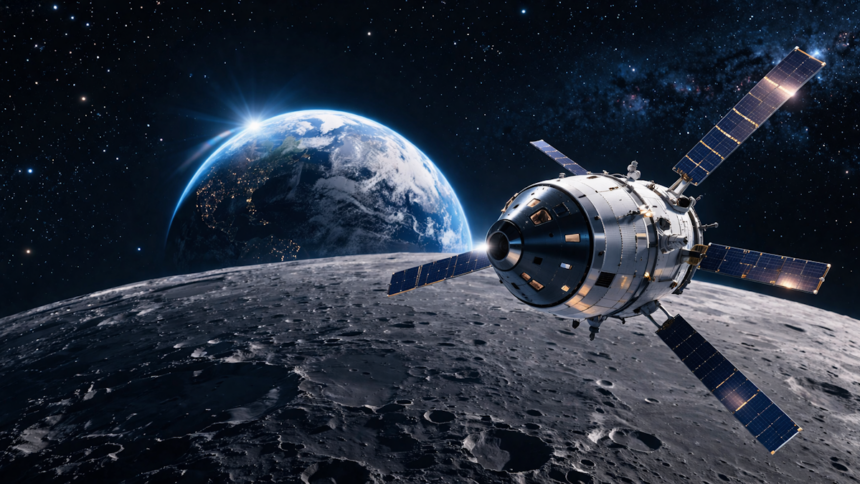
We have become accustomed to looking at screens instead of the sky, with our gaze sunk in ephemeral notifications. But on April 1, 2026, the whole world looked up. Humanity has an almost poetic fixation with re-treading ground that is beyond us, and the Artemis II mission is living proof of that persistence. It's not just about pushing millions of liters of fuel and steel out of the atmosphere; it's about four human beings facing the crushing loneliness of deep space, trusting their lives to lines of code and heat shields for the first time in more than half a century.
- The rebirth of human instinct: Why Artemis II?
- Anatomy of a journey: 10 days on the edge of the cosmic abyss
- Lift-off and Translunar Injection (April 1, 2026)
- The Flyover and Solar Eclipse (April 6, 2026)
- The imminent return home (April 10, 2026)
- The Crew: Four souls, one capsule
- Survival Engineering: The SLS colossus and the Orion spacecraft
- Curiosities and Secrets that nobody tells you
- The next step into darkness: Artemis III
The Artemis II mission is the first manned flight in the U.S. lunar program. POT since 1972. Launched on April 1, 2026 aboard the colossal SLS rocket, it carried four astronauts on a critical 10-day journey around the Moon inside the Orion spacecraft.. After surviving a historic lunar flyby and loss of dark side communication on April 6, the crew is currently adjusting its trajectory for a high-speed splashdown in the Pacific Ocean, scheduled for April 10, 2026. The truth is that we are not simply repeating history. We are rewriting it under the pressure of the 21st century.
The rebirth of human instinct: Why Artemis II?
For decades, manned space exploration was limited to low Earth orbit, orbiting comfortably on the International Space Station (ISS). We accepted the safety of the known. However, the stagnant narrative of staying close to home began to stifle technological advancement.
Artemis II was born as the technical and human response to an urgent need: to prove that our new deep exploration infrastructures are habitable, safe and operational before attempting a lunar landing on future missions.
From Apollo to Artemis: The Generation Gap
Unlike the Apollo program, which was driven by Cold War war adrenaline and the need to plant a flag before the adversary, Artemis has a completely different philosophy. This time we're not going to win a race. We're going to stay.
The main objective of Artemis II is to subject the Orion spacecraft to a brutal stress test with humans on board. They evaluated the life support system, the navigation hardware, and the crew's ability to perform manual piloting in the vacuum of space. If the radiation measurements fail, if the CO2 filters saturate, or if the heat shield shows the slightest fracture, the entire lunar colonization program planned for 2028 collapses.
Anatomy of a journey: 10 days on the edge of the cosmic abyss
Any aerospace engineer will tell you that space is unforgiving of miscalculations. The trajectory of this mission was designed to the millimeter to be bold but contain a gravitational “safety net”.
Lift-off and Translunar Injection (April 1, 2026)
The launch from Complex 39B at Kennedy Space Center was deafening. The Space Launch System (SLS), the most powerful rocket ever built by the POT, tore up the Florida sky.
After reaching low Earth orbit, the Interim Cryogenic Propulsion Stage (ICPS) fired its engines, raising apogee and initiating Translunar Injection. At that moment, the Orion capsule said goodbye to Earth's gravity and launched on a direct trajectory toward our natural satellite.
The Flyover and Solar Eclipse (April 6, 2026)
Here comes the good stuff. Monday, April 6, 2026 was marked in the history books. The Orion capsule passed within 9,000 kilometers of the lunar surface. Crossing to the far side of the Moon, the crew experienced one of the toughest psychological and technical tests: 40 minutes of total signal loss.
Isolated from Mission Control in Houston, the four astronauts were the first modern humans to see with their own eyes the uncharted terrain of the dark side. But the cosmos gifted them with something even more overwhelming. From their unique perspective, they observed a solar eclipse from behind the Moon, an astronomical event that no earthly lens can capture with the same emotional charge. Soon after, they witnessed a breathtaking “Earthrise,” the fragile pale blue dot emerging above the gray lunar horizon.
The imminent return home (April 10, 2026)
As of this writing (April 9, 2026), the crew is executing trajectory corrections and space radiation shelter construction tests. On Friday, April 10, the Orion spacecraft will face its final judgment.
The service module will separate and the capsule will re-enter the Earth's atmosphere at an insane speed of 40,000 km/h. Atmospheric friction will test the heat shield before a complex system of eleven parachutes deploys, slowing the spacecraft to a gentle 27 km/h to splash down off the coast of San Diego, California.
The Crew: Four souls, one capsule
The fixation with the machine sometimes makes us forget the humans inside. The Artemis II mission broke Apollo's demographic barriers, carrying a crew that reflects the modern social fabric.
Reid Wiseman (Commander, NASA): A veteran pilot who carries on his shoulders the pressure of leading the human return to deep space.
Victor Glover (Pilot, NASA): The first African-American on a lunar mission. His role is critical in the Orion manual control tests.
Christina Koch (Mission Specialist, NASA): Record holder for the longest single space flight by a woman. Her technical expertise is the scientific pillar on board.
Jeremy Hansen (Mission Specialist, CSA): The first Canadian to travel beyond low Earth orbit. His inclusion is a direct result of the international partnership and development of Canadarm3.
Survival Engineering: The SLS colossus and the Orion spacecraft
To avoid falling into a loop of technical failures, NASA did not reinvent the wheel in a day, but iterated on technologies inherited from the space shuttles, but taken to a hyper-efficient extreme.
The SLS rocket is a heavy-lift beast designed specifically to eject mass out of Earth's gravity. However, the real jewel in the crown is the Orion Ship.
Unlike the tiny Apollo Command Module, where astronauts could barely stretch out their arms, the Orion has a larger 50% pressurized volume. It is equipped with advanced regenerative life support systems, optical navigation technology that can navigate by the stars if computers fail, and a European Service Module (ESM) that supplies propulsion, water and oxygen.
Technical Chart: Artemis II vs Misiones Históricas
| Parameter | Apollo 8 (1968) | Apollo 13 (1970) | Artemis II (2026) |
| Trajectory | Lunar Orbit | Free (Forced) Return | Free Return (Planned) |
| Crew | 3 Astronauts | 3 Astronauts | 4 Astronauts |
| Duration | 6 days | 5 days, 22 hours | 10 days |
| Main Focus | First overflight | Disaster survival | Comprehensive systems testing |
Curiosities and Secrets that nobody tells you
Although there is no shortage of opportunities for something to go wrong, applying the popular adage of Murphy's laws, the mission has been plagued by impressive cultural milestones.
A fascinating detail of Artemis II is how the world consumed the lunar overflight. NASA closed massive technology partnerships, allowing platforms such as Netflix to live stream the views from the capsule on April 6, bringing the abyss of space right to the couch of millions of homes. The cosmos was democratized in real time.
In addition, the spacesuits inside the Orion are not simple pressurized coveralls. They are called Orion Crew Survival System and are designed to keep astronauts alive for up to six days in the event of a total cabin decompression, drastically exceeding the Apollo-era survival limit.
The next step into darkness: Artemis III
Friday's splashdown was successful, and with it came the 4 astronauts with many anecdotes and information. By keeping the Orion in a constant cycle of data collection and overcoming thermal stress, we will have ensured the real growth of the space program.
Artemis III, the final link in this first phase, will aim for the unthinkable: landing on the moon. With combined technology from SpaceX (Starship HLS) and the data collected by Wiseman, Glover, Koch and Hansen, the human being will walk on the lunar south polar ice before the end of this decade.
Ultimately, Artemis II is a reminder that, even in pitch darkness hundreds of thousands of miles from home, human resilience always finds a way to navigate back to the light.
Image: Geekine.com








 Español de Colombia
 English
 Português do Brasil